Pool Maintenance · Scottsdale, Arizona

Pool Maintenance Scottsdale AZ

Dependable routine care that keeps your water clear, equipment working properly, and pool ready when you want to swim.

✓Scheduled routine care ✓Water testing and balancing ✓Equipment condition checks
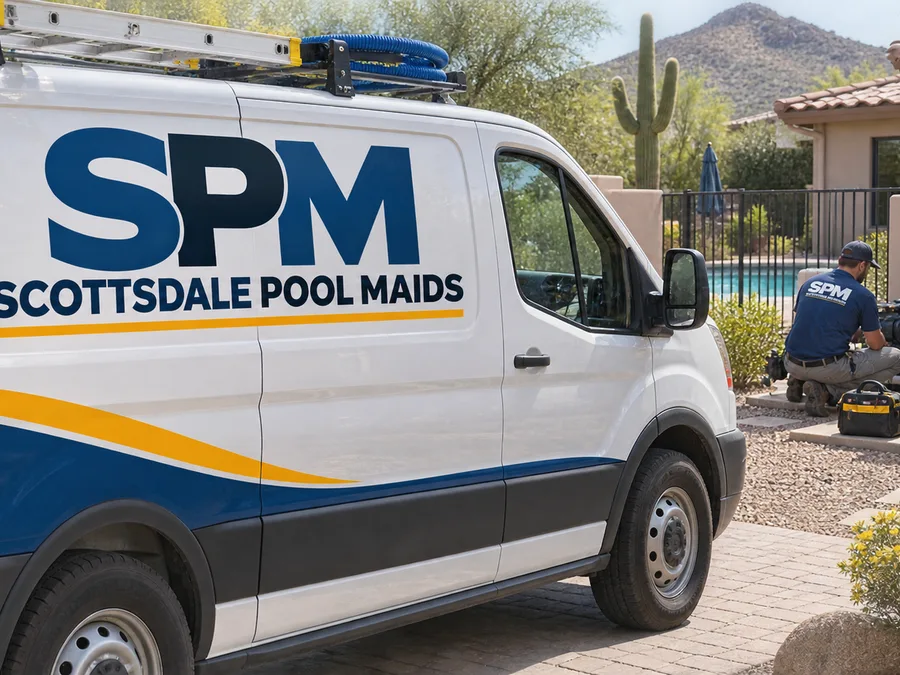
A clean residential swimming pool in Scottsdale with clear blue water, brushed tile, and well-kept surrounding decking.

Reliable Care for a Clean, Swim-Ready Pool

Pool maintenance in Scottsdale, AZ needs to account for intense sun, windblown dust, fine debris, and heavy use during warm weather. Water can lose sanitizer quickly under strong ultraviolet exposure, while leaves and dust place added demand on circulation and filtration. Consistent testing and cleaning help prevent cloudy water, algae growth, scaling, staining, and unnecessary strain on pool equipment.

Scottsdale Pool Maids provides scheduled care based on the pool's condition, equipment, finish, exposure, and use. During each service, Scottsdale's trusted pool team inspects the water and visible equipment, records what needs attention, and explains when maintenance or a repair should not wait. The goal is straightforward: stable water chemistry, effective circulation, a clean vessel, and fewer avoidable problems.

Complete Routine Care

What Scottsdale Pool Maintenance Covers

Water Testing and Balancing

Service includes checking key chemistry readings and making appropriate adjustments. Free chlorine, pH, total alkalinity, calcium hardness, and cyanuric acid each affect sanitation, swimmer comfort, surface protection, and the performance of other chemicals.

Skimming, Brushing, and Debris Removal

Leaves and floating debris are removed before they settle. Walls, steps, benches, tile lines, and areas with weak circulation are brushed as needed to disrupt buildup and help prevent algae from taking hold.

Filter and Basket Care

Skimmer baskets and pump baskets are cleared so water can move freely. Filter pressure and condition are checked, with cleaning recommended when the filter's normal operating pressure or water flow indicates that service is due.

Equipment Checks

The pump, filter, visible plumbing, valves, cleaner, and other accessible components receive a visual operating check. Leaks, unusual noise, weak returns, air in the pump basket, or pressure changes can point to a developing issue.

Condition-Based Adjustments

Chemical demand changes with sunlight, swimmer load, storms, debris, and water replacement. Maintenance decisions should follow current test results rather than a fixed chemical dose used at every visit.

Clear Service Notes

Useful service records identify completed work, current water conditions, and items that need monitoring. This makes recurring changes easier to spot and gives the pool owner a clear account of its condition.

Desert-Aware Service

Pool Maintenance for Scottsdale's Desert Conditions

Strong Arizona sunlight can reduce available chlorine, so cyanuric acid is commonly used in outdoor pools to protect chlorine from rapid ultraviolet degradation. Too little stabilizer can increase sanitizer demand, while excessive stabilizer can make chlorine management more difficult. Accurate testing matters more than simply adding extra chemicals.

Wind and seasonal dust can also load skimmer baskets and filters faster than expected. Pools near open desert areas around Troon may receive more windblown debris, while mature landscaping in McCormick Ranch can add leaves and organic material. In Old Town Scottsdale, smaller yards and nearby hardscape may affect equipment access and how debris enters the water. DC Ranch and Gainey Ranch include pools with varied water features and equipment arrangements, which can require different circulation and cleaning routines.

A good plan responds to those conditions without overcorrecting. Adding chemicals before checking the water can create new balance problems, and running equipment without clearing restricted baskets can reduce flow. Scottsdale pool maintenance should combine testing, physical cleaning, and equipment observation at each scheduled service.

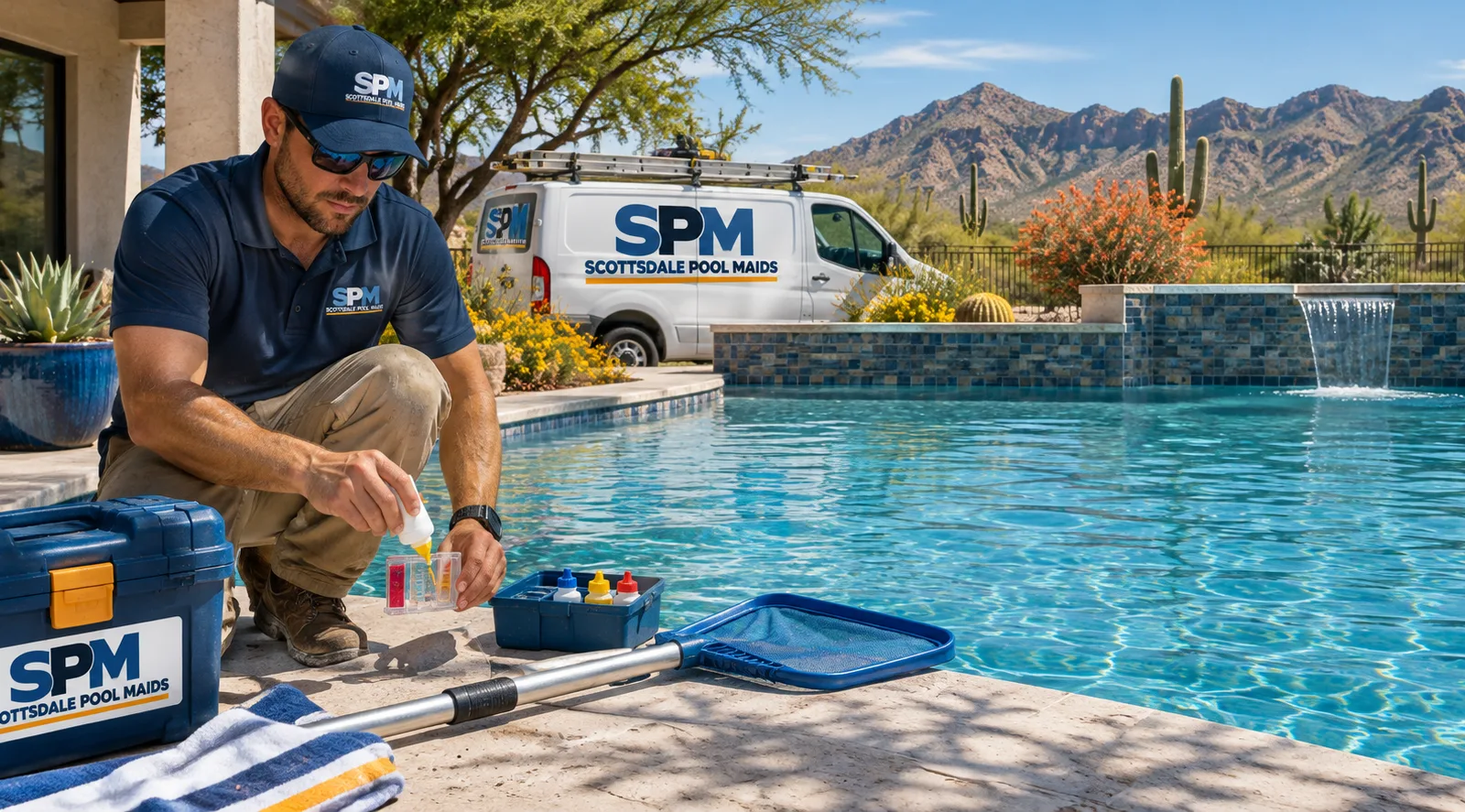
A pool maintenance professional testing water beside a Scottsdale residential pool, with a test kit, skimmer, and desert-adapted yard visible.
Water testing guides chemical adjustments for the pool's current condition.

Scheduled Service Process

How Our Maintenance Visits Work

  1. 01

    Inspect the Pool and Equipment

    The visit begins with a visual check of water clarity, debris, water level, circulation, and accessible equipment. Signs such as cloudy water, surface buildup, weak returns, leaks, or abnormal filter pressure are noted.

  2. 02

    Test the Water

    Current readings guide treatment. Testing typically focuses on sanitizer, pH, total alkalinity, calcium hardness, and stabilizer, with other tests used when the pool's condition calls for them.

  3. 03

    Clean the Pool

    The surface is skimmed, baskets are emptied, and walls, steps, benches, and the waterline are brushed as needed. Settled debris is addressed according to the pool's cleaning system and service needs.

  4. 04

    Balance the Chemistry

    Chemicals are adjusted based on measured results, pool volume, finish, and current conditions. The purpose is to maintain effective sanitation while protecting surfaces and equipment from corrosive or scale-forming water.

  5. 05

    Check Operation and Document Concerns

    Circulation and visible equipment are checked again after service. Any condition requiring monitoring, filter care, troubleshooting, or repair is documented so the owner can make an informed decision.

Connected Pool Systems

Chemistry, Circulation, and Filtration Work Together

Clear water alone does not prove that a pool is properly maintained. Sanitizer must remain effective, pH should stay in a range that supports swimmer comfort and chlorine performance, and balanced water helps protect plaster, tile, metal components, and heaters. Total alkalinity buffers pH movement. Calcium hardness and the overall saturation balance influence whether water tends to become corrosive or form scale.

Circulation carries treated water throughout the pool and moves debris toward the skimmer and filter. A clogged basket, dirty filter, blocked cleaner, closed valve, or low water level can reduce that flow. Dead spots around steps, benches, corners, and water features deserve close attention because weak circulation can allow debris or algae to collect.

Filters also need care suited to their type. Cartridge filters are removed and cleaned when pressure and condition indicate it. Sand and diatomaceous earth filters have different maintenance procedures. The filter's baseline clean pressure is more useful than relying on a single universal pressure reading, since plumbing and equipment layouts differ between pools.

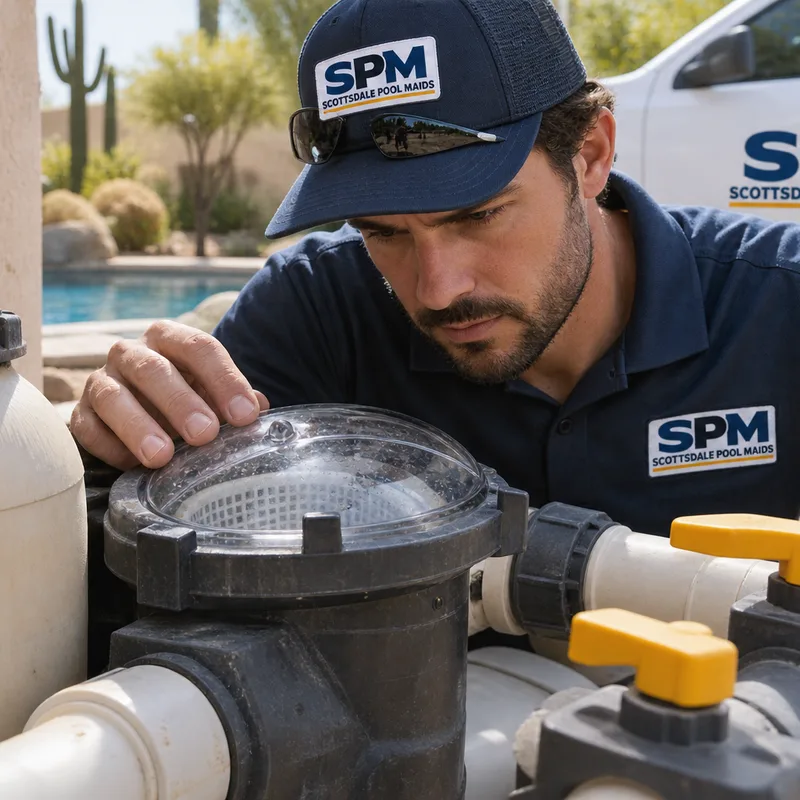
Close view of a technician inspecting a pool pump, filter gauge, clear pump lid, and connected valves during a maintenance visit.
Changes in pressure, flow, sound, or visible leakage can reveal equipment trouble early.

Maintenance Warning Signs

Signs Your Pool Needs Prompt Attention

Green or cloudy water, slippery walls, recurring algae, rapid chlorine loss, and a strong chemical odor all deserve investigation. A strong odor often comes from chloramines and inadequate oxidation rather than an excess of properly functioning free chlorine. Swimmers should stay out if the bottom cannot be seen clearly or if testing shows unsafe chemistry.

Equipment symptoms matter too. Low flow at the returns, air under the pump lid, a pump that loses prime, rising filter pressure, water around equipment, or a cleaner that stops moving may indicate a restriction, leak, or mechanical fault. Maintenance can identify these warning signs, but repairs should be diagnosed before parts are replaced.

Surface changes should not be ignored. White deposits along tile, rough areas on the finish, discoloration, and persistent waterline buildup may be associated with scale, metals, organic material, or water balance. Early assessment often keeps a localized condition from becoming a broader cleaning or repair issue.

Service Pricing Factors

How Much Does Pool Maintenance Cost in Scottsdale?

Weekly pool maintenance in Scottsdale typically costs about $120 to $250 per month for a standard residential pool. Larger pools, attached spas, water features, heavy debris, specialty finishes, and more involved chemical needs can raise the price. Confirm whether chemicals, filter cleaning, salt-cell care, and corrective treatments are included, since service plans differ. Equipment condition, access, visit frequency, and the starting state of the water also affect pricing. The exact cost is confirmed after the pool and equipment are inspected.

A consistent maintenance plan can reduce recurring algae, unstable chemistry, and equipment stress. Tell us about your pool, its current condition, and any concerns you have noticed so we can recommend an appropriate service approach.

Practical Answers

Questions About Swimming Pool Maintenance in Scottsdale, AZ

How often should a Scottsdale pool be serviced?

Weekly service is a common starting point for an outdoor Scottsdale pool because heat, strong sunlight, dust, and swimmer use can change water conditions quickly. The right frequency depends on exposure, pool size, landscaping, equipment, and use. A pool with heavy debris or an active water problem may need additional attention until conditions stabilize.

Are pool chemicals included with regular maintenance?

Chemical inclusion depends on the service plan and should be confirmed in the written scope. Ask whether routine sanitizer and balancing chemicals are included, and whether specialty products, shock treatments, phosphate treatment, salt, stabilizer, or startup chemicals are billed separately. Scottsdale's intense sun can increase sanitizer demand, making these details especially relevant.

Can maintenance clear a green or cloudy pool?

Many green or cloudy pools can be restored, but the treatment depends on the cause and may fall outside routine maintenance. The process can require testing, chlorine treatment, brushing, filtration, filter cleaning, and repeated visits. Circulation problems, excessive stabilizer, algae, fine dust, or an equipment fault must be addressed rather than hidden with clarifier.

How long does it take to stabilize neglected pool water?

A mildly unbalanced pool may improve after a service visit, while algae, severe cloudiness, heavy debris, or circulation trouble can require several days and repeated treatment. Filtration needs time to remove suspended material. Arizona heat and sunlight can also increase chemical demand during recovery, so treatment is adjusted using follow-up readings.

Does regular service include pool equipment repairs?

Routine service usually includes visual operating checks, while repair labor and replacement parts are priced separately. A maintenance visit can reveal leaking seals, weak flow, unusual pump noise, damaged baskets, pressure changes, or cleaner problems. Proper diagnosis should identify whether the cause is maintenance-related, hydraulic, electrical, or mechanical.

Can you maintain a saltwater pool in Scottsdale?

Yes, saltwater pools still need regular cleaning, water testing, and equipment checks. The salt chlorine generator produces chlorine, but pH, alkalinity, calcium hardness, stabilizer, salinity, and cell condition still require attention. Scottsdale heat and evaporation can affect concentration and scale risk, so the system should be managed as a complete pool rather than treated as maintenance-free.

What should I ask before choosing a pool maintenance company?

Ask exactly what each visit includes, how chemistry is documented, which chemicals are covered, and how filter cleaning or repairs are authorized. You should also know the normal service frequency and how urgent water or equipment concerns are communicated. A written scope makes competing Scottsdale pool maintenance plans easier to compare.

Keep Your Pool Clean, Balanced, and Ready to Use

Share your pool's size, equipment, current condition, and maintenance concerns. Scottsdale Pool Maids will help define a practical service scope and the next steps for dependable ongoing care.