Pool Service · Scottsdale, Arizona

Pool Service in Scottsdale, AZ

Keep your pool clear, balanced, and ready to use with consistent maintenance, careful equipment checks, and practical repair recommendations.

✓Measured water treatment ✓Equipment checks ✓Desert-aware maintenance
A pool service technician testing clear water beside a well-maintained residential swimming pool in Scottsdale.

Scottsdale sun, evaporation, dust, and monsoon weather make consistent chemistry, filtration, and equipment observation essential.

Complete Pool Care

Dependable Care for Your Pool and Equipment

Professional pool service in Scottsdale should do more than improve the water's appearance. It should maintain safe chemistry, support effective circulation, remove debris, and catch equipment trouble before a small fault interrupts filtration.

Scottsdale's desert conditions create a demanding maintenance cycle. Wind can carry dust and plant debris into the water, intense sun consumes chlorine faster, and high evaporation changes water level and chemistry. During monsoon weather, a pool may need extra debris removal, filter attention, and chemical correction after dust or runoff enters the water.

Scottsdale Pool Maids provides routine care based on the condition of the water, pool surfaces, and equipment. With an experienced pool team in Scottsdale handling the work, each visit considers the complete operating system rather than being a quick skim-and-go appointment. That means checking what affects water quality today while watching for wear that may lead to a repair later.

Water, Cleaning, and Equipment

What Pool Service in Scottsdale Includes

Water Testing and Balancing

Service should include testing appropriate chemistry factors such as free chlorine, pH, total alkalinity, and cyanuric acid. Calcium hardness and salt levels may also need periodic checks based on the pool and sanitation system.

Surface and Debris Cleaning

Skimming, brushing, and vacuuming help remove leaves, dust, and sediment before they contribute to staining, algae growth, or poor water clarity. Steps, corners, tile lines, and low-circulation areas deserve close attention.

Filter and Basket Care

Pump baskets, skimmer baskets, and filters collect material that restricts flow. Cleaning schedules depend on debris load, filter type, and pressure readings rather than a single calendar rule.

Equipment Inspection

A visual and operational check can identify leaking seals, unusual pump noise, poor return flow, damaged valves, or heater and automation concerns. Early findings make it easier to plan repairs.

Chemical Application

Chemicals are added according to test results, pool volume, surface type, and current conditions. Measured treatment is safer and more effective than relying on appearance alone.

Service Reporting

Clear notes should explain completed work, chemistry concerns, equipment observations, and any action the owner needs to take before the next visit.

Desert-Aware Maintenance

Pool Maintenance Built for Desert Conditions

Arizona heat changes how a pool behaves. Strong sunlight breaks down unprotected chlorine, while evaporation concentrates dissolved minerals and requires regular water replacement. A low water level can also interfere with skimming and may allow a pump to draw air. These conditions make consistent observation especially useful during the hottest part of the year.

Conditions also vary across individual properties. Pools near desert vegetation in North Scottsdale may collect fine organic debris and dust. Mature landscaping around McCormick Ranch can add leaves, seed pods, and pollen. In Old Town Scottsdale, smaller lots and enclosed courtyards can affect equipment access. Properties around Gainey Ranch may have water features or attached spas that add valves, pumps, and operating modes to inspect. These are practical service factors, not reasons to apply the same checklist to every pool.

Balanced water protects more than swimmers. Chronically low pH can be corrosive, while scale-forming water can leave deposits on tile, heaters, and salt cells. A technician should evaluate chemistry trends over time and consider the finish, equipment, sanitation method, and recent weather before making corrections.

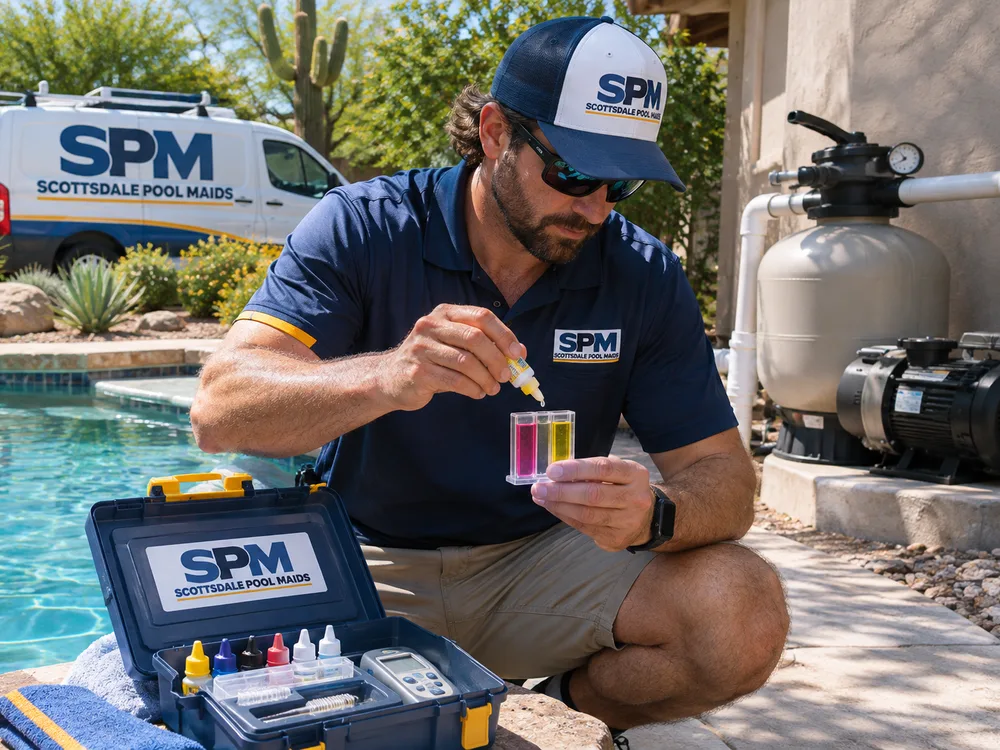
A technician using a professional test kit beside a Scottsdale pool, with the pump and filter equipment visible in the background.
Accurate testing guides chemical treatment and helps protect pool surfaces and equipment.

From Inspection to Reporting

How Routine Pool Care Works

  1. 01

    Inspect the Pool and Water Level

    The visit starts with a visual check of water clarity, debris, water level, pool surfaces, and visible signs of algae or staining. The technician also looks for active leaks or other conditions that need prompt attention.

  2. 02

    Test and Adjust the Water

    Chemistry is tested before treatment. Necessary adjustments are based on measured results, pool volume, sanitation system, and whether recent weather or heavy use has changed demand.

  3. 03

    Clean the Pool

    Floating debris is removed, walls and steps are brushed as needed, and settled material is vacuumed or removed through the pool's cleaning system. Baskets are emptied so water can move freely.

  4. 04

    Check Circulation Equipment

    The pump, filter, valves, returns, cleaner, and accessible plumbing are observed during operation. Filter pressure and flow can reveal restrictions, dirty media, air intrusion, or equipment problems.

  5. 05

    Record Findings and Recommend Repairs

    Completed work and notable conditions are documented. If equipment needs attention, the recommendation should identify the affected component and explain whether the issue is urgent or can be planned.

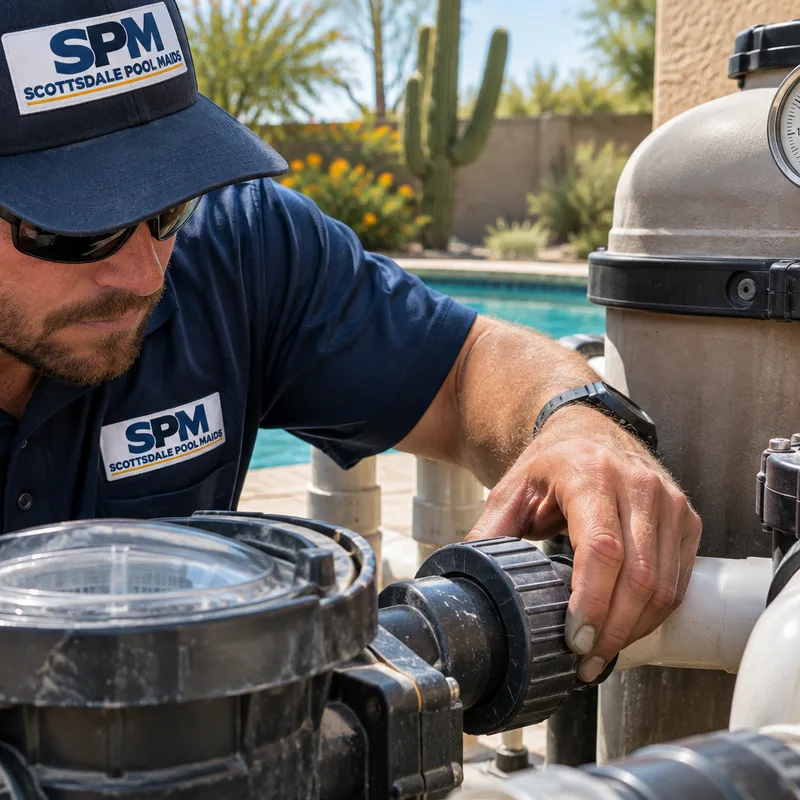
Close view of a pool technician inspecting pump unions, valves, filter pressure, and accessible plumbing at a tidy residential equipment pad.
Operational checks can reveal restricted flow, leaks, and worn components before circulation stops.

Connected Pool Care

Cleaning and Repair Belong in the Same Service Plan

Clean water depends on working equipment. A pool can receive the right chemicals and still turn cloudy when circulation is weak, the filter is overloaded, or the pump is pulling air. Conversely, a sound equipment pad cannot compensate for neglected brushing or poorly managed chemistry.

Common service findings include clogged baskets, dirty filter elements, leaking pump lids, worn seals, failed pressure gauges, sticking valves, weak cleaner movement, and salt-cell scale. Diagnosis matters because similar symptoms can have different causes. Low return flow, for example, may come from a clogged basket, a dirty filter, an obstructed line, or air entering the suction side.

Repairs should start with an inspection and a defined scope. The technician should identify the failed part, evaluate related components, and explain whether repair or replacement is the practical choice. Equipment should never be opened or serviced while energized, and gas heaters require appropriate care because they combine fuel, electricity, water flow, and combustion controls.


Planning Your Service

How Much Does Pool Service Cost in Scottsdale?

Routine pool service in Scottsdale typically costs about $120 to $250 per month for a standard residential pool, while one-time cleanups may run roughly $150 to $500 or more. Chemical inclusion, visit frequency, pool size, attached spas, water features, debris load, and current water condition affect the price.

Repairs are priced separately because parts, access, equipment type, and diagnostic time vary. Green water recovery or neglected filters may also require extra visits. The exact cost is confirmed after the pool and equipment are inspected.

Know When to Act

When to Schedule Additional Attention

Routine visits handle normal maintenance, but some conditions should not wait for the next scheduled appointment. Prompt evaluation is sensible when the pump loses prime, water stops moving at the returns, a breaker repeatedly trips, equipment leaks steadily, or the water level drops faster than normal evaporation would suggest. Shut down equipment if operating it may cause damage, and keep people away from any exposed electrical component.

Cloudy or green water also needs diagnosis rather than an automatic dose of chemicals. A complete response may involve circulation correction, filter cleaning, brushing, sanitation, and repeated testing. After a Scottsdale dust storm, the filter pressure and basket load can change quickly even when the water initially looks acceptable.

Before hiring a provider, ask what each visit includes, whether chemicals are included, how filter cleaning is billed, and how equipment concerns are reported. It also helps to know whether the same scheduled tasks are performed year-round or adjusted for temperature, sunlight, debris, and pool use. Written service records make chemistry trends and recurring equipment symptoms easier to track.

If the water has lost clarity, the equipment sounds different, or routine upkeep has become inconsistent, arrange an inspection and get a clear service plan based on the pool's actual condition.

Request Service

Practical Answers

Pool Service Questions from Scottsdale Owners

How often should I schedule pool service in Scottsdale, AZ?

Weekly service is a common schedule for residential pools in Scottsdale because heat, sunlight, evaporation, and airborne dust can change conditions quickly. The right frequency also depends on swimmer use, landscaping, pool size, sanitation system, and whether the owner handles any tasks between professional visits.

Are pool chemicals included in monthly service?

Chemical inclusion depends on the service agreement and should be confirmed in writing before work starts. Ask whether the rate covers routine chlorine and balancing chemicals, and whether specialty treatments, salt, stabilizer, phosphate remover, or green-pool recovery are billed separately.

Can a pool be serviced while I am away?

Yes, pool service can usually continue while an owner is away if the technician has safe access to the pool and equipment. Scottsdale owners who travel during hot weather should also arrange a way to maintain the proper water level, since evaporation can lower it enough to affect skimming or pump operation.

Why does my Scottsdale pool keep getting cloudy?

Persistent cloudiness usually points to a chemistry, filtration, or circulation problem rather than debris alone. High swimmer load, fine desert dust, insufficient sanitizer, a dirty filter, short run times, or poor water balance may contribute, so testing and an equipment check should come before treatment.

How long does it take to clear a green pool?

A green pool may take several days or longer to recover, depending on algae severity, water balance, filtration capacity, and whether the equipment is operating correctly. Treatment often requires brushing, sustained filtration, filter cleaning, sanitizer correction, and follow-up testing rather than a single visit.

When should a pool filter be cleaned?

A filter should be cleaned according to its pressure increase, debris load, and manufacturer guidance, not solely by date. A notable rise above the clean starting pressure often signals restricted flow, and Scottsdale dust or monsoon debris can shorten the interval between cleanings.

Can a technician repair my pump during a maintenance visit?

Minor corrections may be possible during a maintenance visit, but many pump repairs require diagnosis, parts, and separate approval. A useful repair scope identifies whether the problem involves power, priming, seals, the motor, the impeller, plumbing, or another component before costs are authorized.

What should I do after a Scottsdale dust storm?

Remove heavy debris, check baskets and water level, and monitor filter pressure after a Scottsdale dust storm. Fine particles may require vacuuming and additional filtration, while major chemistry changes should be based on test results rather than assumed from the pool's appearance.

Ready for More Reliable Pool Care?

Tell Scottsdale Pool Maids about your pool, current maintenance routine, and any water or equipment concerns. You will have a clearer basis for choosing ongoing service, a focused cleanup, or repair work.